Sunday, 26 March 2017

Never mind the Punc Eq, where's Adam and Eve?: SJ takes on genetics

I've had a lengthy response to my objections to Christianity from SJ Thomason. Rather than analysing it in one go, I'm going to break this down into smaller (and hopefully more readable formats).


The Red Herring

S.J. Thomason responds:

Let me begin by noting his reference to the flavor of Christianity. I draw attention to this statement because atheists often ask Christians to identify the “correct” Christian sect. I am of the opinion that so long as the Christian sect draws its knowledge from the Bible, embraces Jesus Christ’s divinity, and encourages people to live by the example of Jesus Christ, then the sect is correct.
This is a red herring. It would be relevant to state whether the belief in Adam and Eve in the sect the reader belongs to, are supposed to literally exist, or exist as allegories instead.


People have varying needs in the ways they grow closer to God. 
 The rest of this paragraph has nothing to do with the genetics problem. It's a description of SJ Thomason's beliefs. This suffers the defects of being irrelevant to my objection, and is boring. 

Some prefer liturgical, ritualistic churches in which the congregation sings hymns and develops an appreciation of sacraments and traditions, such as the Lutheran and Catholic churches. Others might prefer contemporary sorts of churches in which the congregation sings contemporary Christian songs and listens to informative sermons on the Bible, such as the Baptist church. Other churches blend these options and offer various interpretations of the Bible based on variations of adherence to literal interpretations of the Bible. No matter the door, all ultimately lead to Jesus. “The door on which we have been knocking all our lives will be open at last” (Lewis, 1949).


The Strawman Fallacy

To answer Kaimatai’s next issue, which speaks to the origins of the universe, earth, and life on earth, I draw from Hugh Ross and his book Improbable Planet.
And straight to the strawman fallacy.  I gave as a specific example that genetics refuted that a literal Adam and Eve existed.  These are examples of an absence of evidence where there should be evidence.


“The Milky Way Galaxy, the Sun, the Moon, and the configuration of the solar system’s planets and asteroid belts reveal how Earth obtained its unique stockpile of elements and minerals that enable Earth today to sustain such an enormous biomass and biodiversity. The fossil record, isotope records, geological layers, sediment cores, ice cores, and biodeposit (biological decay products embedded in Earth’s crust) inventories provide biologists and ecologists with a chronicle of Earth’s life. Earth’s preserved record of past physical and biological events reveals an unanticipated synergy (p. 16-17).”
The conspicuous feature of the paragraph is the absence of any mention of genetics.  It's irrelevant.


“Charles Darwin presumed that the development and transformation of life throughout Earth’s history was gradual, smooth, and continuous. 
 That was in 1859.  And it was a hypothesis, that even some of his supporters (like Huxley) remained unconvinced by.  By the early 1950s, the development of population biology and speciation modes like allopatric speciation, had undermined this gradualistic view.  It persisted longer in paleontology however. 


The Appeal to (False) Authority


However, in landmark articles published in 1972 and 1977, paleontologists Niles Eldredge and Stephen Jay Gould pointed out that the fossil record is typified by species remaining in extended stasis (little or no net evolutionary change) interrupted by quantum jumps where species suddenly disappear and then are followed quickly by sudden appearances of very different species
Correct, as a necessary consequence of speciation beginning from small populations, where the odds of leaving fossils behind are very unlikely because the populations are too small! Not because evolution works by jumps.   And we have plenty of good examples of gradual change occurring in the fossil record.

This argument is completely fallacious. Ross isn't an evolutionary biologist, or geneticist, or paleontologist.  He's a physicist. He doesn't have a clue what he's talking about. 
…It is not only at the species level where quantum jumps are observed but also at the level of families, orders, and classes of organisms (p. 19).
I'm sorry, but what did I just read!?  Pretty much all terrestrial animals are just one thing. A segmented worm-like creature with optional appendages.  We're bilateral triploblasts.  There aren't "quantum leaps". Just some tinkering with an animal with a feeding tube that runs down the centre.


“Primitive life, that is unicellular bacterial life, is but the simplest form of life on Earth. There are three other general divisions of purely physical life: (1) differentiated multicellular organisms (for example, fungi); (2) plants; and (3) animals. 
 Oh the stupid just burns now. There are three domains of life. The three divisions mentioned here make up just one of them. I know Ross is old, but it looks like he learned his biology from Darwin himself.


In addition to purely physical life, Earth today contains two kinds of life that possess distinctly nonphysical attributes. One of these kinds is a group of animals that possess a mind…that is capable of experiencing and expressing emotions, exercising intellectual analysis, and making decisions in response to that analysis and the animal’s emotional state. All mind-possessing animals share in common the attribute of parents providing sacrificial care for their offspring. Animals in this category include all mammals and birds and a few of the more advanced reptilian species such as the crocodile and the alligator” (p. 21).
 Sigh, "advanced" is not a thing in biology.

Putting the Cart before the Horse


“Another kind of life-form possessing nonphysical attributes is the species Homo sapiens sapiens. Human beings not only possess a mind, but they are also endowed with a spirit…(which) enables humans to engage in philosophy and theology and to address questions of ultimate meaning and purpose” (p. 21).
 The claim we have a spirit is a religious one. As it is embedded in the god-belief, which is disputed, the argument is a fallacious 'affirming the consequent'. Ross is putting the cart-before-the-horse. 

Again, this is irrelevant to my objection, and is resorting to an appeal to (false) authority. 


Argument by Assertion Fallacy


In other words, the earth today contains diverse and abundant species in multiple levels of advanced life, many of which appeared suddenly via quantum jumps. Such an explanation helps to explain the way the most advanced life forms possess consciousness (i.e., awareness) and spirituality, while less advanced life forms do not. Such an explanation further suggests that the first humans appeared suddenly.

  1. 1. There's no such thing as more or less advanced in biology. Organisms can have basal or derived characters.  The idea of 'advancement' is a religious relic based on the Scalae Naturae. It does not exist. 
  2. 2. Molecular evidence shows that species don't appear in sudden leaps. Fossils are a function of population abundance. Species that originate with low populations leave few or no fossils. Molecular evidence shows that we don't see leaps. 
    1.  The decoding of the mouse genome showed that over 99% of the coding genes in a mouse and a human were the same.  A 1% change of over 65-75my isn't a jump.
  3. Humans didn't appear suddenly.  That's what the genetic evidence tells us. 

Final Score

So as far as a rebuttal goes, it's a complete fail. 
  •  The genetic evidence against a recent human origin from two individuals was not addressed. No evidence from the field of genetics was even produced!
  • A strawman argument was conjured in its place
  • An appeal to authority was attempted, but the authority was ignorant of the topic at hand!
  • Assertions were frequently just wrong.


Saturday, 25 March 2017

That Kalam argument

Sooner or later as an atheist on the web, you're going to run into the Cosmological Argument.  This often comes in the form of the "Kalam argument" or its modern form promoted by William Craig.

It's typically presented as a syllogism. This a logical argument that used two related premises to reach a conclusion.

  • P1: Whatever begins to exist has a cause;
  • P2: The universe began to exist;
  • C: The universe has a cause
A Rapidly Inflating Singularity Explains Many of the Attributes of this Universe
(Figure via Shutterstock as Stock illustration ID: 489781135)


As the argument does not include any deities, it is imputed that this cause, must itself be uncaused.  Conveniently theists knew what this cause was all along. This is their favourite deity, which by fiat is eternal, existing outside time and space and, uncaused.

The popularity of the syllogism doesn't disguise its flaws.  It is these flaws that have prevented a stampede of atheists toward Christianity.  Let me elaborate.

A syllogism depends on the its premises being correct.  It is not good enough for them to be possibly correct.  And there are reasons to suspect the premises are not.

Let's look at the first.

How do we know that everything that begins to exist has a cause?

  • The reason we have the qualification "begins to exist" is to exclude deities with eternal properties.  If it was just 'exists' then the syllogism would net in gods too.  In short, it is a special pleading fallacy introduced right at the start.  How do we know deities are able to exist without a beginning?  We don't.  No evidence is attached to prove this.  It's just one more thing we have to believe about gods on faith alone.
  • It's an uncertain premise.  From what we understand about quantum mechanics, the quantum world behaves stochastically.  It's a random world at that level. Negative and positive sub-atomic particles wink in and out of existence. 
    • The above means that P1 is not self-evident
    • Induction is not strong enough to prove that P1 is correct. We've sampled a tiny fraction of the universe and our observed sample size of universes is still stuck at 1. 
  • It makes the term 'cause' do a lot of work. Here the syllogism tries to conflate causality (in the sense of purposely caused by an agent) with other causality in other contexts (e.g. occurs naturally without intercession because of environment and natural laws). As a term, causes are not really part of the conceptual toolbox of Fundamental Physics.  I'm not convinced at this level, cause is an appropriate term.
  • It is also a category fallacy. Universes don't fall into the same category as phenomenon within the universe.  
  • Similarly, it's not clear what we mean by 'begins to exist'. If time is an emergent property of the universe, then it becomes difficult to talk about a point where the universe 'begins to exist' (see the Hawking-Hartle no-boundary condition).  
In short, P1 is a barely coherent and fallacious premise that has significant scientific objections to overcome.


How do we know the universe began to exist?


We don't. The standard model of the universe converges to a singularity, where the regular laws of physics as we understand them don't apply.  This could be a genuine beginning, or it could be just the observable part of other ways the universe evolved. 

Alternatives include a bouncing universe (our universe originated on another one that collapsed, before bouncing back from a singularity), cyclical (the various ekpyrotic models), reproducing from others etc.  

P2 has yet to be proven to be true.


Does the Universe Have Cause?  


In the sense that some event occurred that initiated an inflationary period for the universe? That seems plausible. For instance, some quantum event is potentially able to cause this.  Does that mean we know that this is how it happened?  No.  But there are natural explanations.  We don't have to invoke gods, and I'm not sure why we would.  What falsifiable hypotheses could we test? What predictions does this make?  The scientific model predicts a flat, homogeneous universe with Cosmic Background Microwave radiation. The divine model predicts a bloodgod who is outwitted by a talking snake, so that he has to mate with a virgin to kill his own offspring because two people ate some fruit.  It's not a good way to build credence.

Gods have a problem as they're not mentioned in the syllogism, and as the syllogism is attempting to prove gods exist, it's not an independent proof of said gods. We do know say, that quantum perturbations do happen. The syllogism for gods starts becoming a little circular at this point.

This lack of evidence for gods makes the whole syllogism unconvincing.  

Summary: Syllogisms aren't Evidence


Syllogisms are interesting logical arguments.  We can say if the premises are true or not, and we can say whether the conclusion follows from these premises.   But they're not evidence, they're either logically true or false.  In this case, the Kalam or first cause argument suffers a plethora of philosophical and scientific flaws. 

Let me conclude with my own syllogism to illustrate this point:

P1: Everything that exists has a natural cause (by induction)*
P2: Gods are supernatural 
C: Gods cannot exist or cause anything that does exist.

* E.g. We've replaced many supernatural explanations with natural, and never a natural explanation with a supernatural.


Monday, 5 December 2016

10 Reasons why I'm not a Christian

Internet Christians seem fond of the "list approach" to proselytizing.  This comes in various forms. Like "10 reasons Christianity is true" or "10 questions atheists can't answer".  So with that inspiration, here are 10 objections I have to the existence of the Bronze-age Deity Yaweh and his magic carpenter son.

1. The absence of evidence where there should be evidence

Depending on your flavour of Christianity, this particular deity is supposed to have created the Universe, formed the earth, begun life, created humanity from just two individuals, intervened frequently in the affairs of a Near Eastern Tribe, and made a personal appearance for approximately 33 years.  Many of these events should leave compelling evidence. Genetics should confirm we descended from just two individuals. Other civilizations should have noticed the extraordinary events described in the bible.  That evidence is just not present.
Genetics confirms that modern human species never originated from just 2 individuals


2. The Soap Test

There are no instructions on using soap.  Soap is a product that is easy to make.  It also has benefits for hygiene as well as reducing infections and limiting the spread of disease.  These effects on disease were not realised until the germ theory of disease was established.

Any deity that is supposed to be benevolent, all-knowing, and interceding to benefit a chosen tribe or people, would give instructions on its use.  Instructions on its use however are weirdly absent.  This neglect would have increased needless suffering (through illness and disease) as well as premature deaths. With no technological barrier to making soap, there is no valid reason to withhold instructions on its use. Given the vast number of people whose lives would have been improved by providing instructions, it's not a trivial issue.

3. The gospels are problematic

Not only are the gospels written well after the alleged events, they contradict each other in key details.  The nativity of Luke and Mark Matthew describe entirely different events.  Unlike Julius Caesar there are no writings of Jesus. No contemporaneous historian, of which there were several in this era, noticed any of the fantastic things described in the gospels.

One feels an omniscient (all-knowing) deity would know this would reduce the confidence non-believers would have in the Jesus-mission. Even Julius Caesar left stuff he wrote. And an all-powerful deity might have ensured the records of the Jesus-mission weren't so dependent on the contradictory, hearsay accounts we have.


4. Prayer doesn't work

Enough children have died in faith-healing cases to show that prayer only succeeds in mundane cases with a high likelihood of occurring anyway. There is no evidence at the population-level that Christians are healthier, live longer or recover from cancer more frequently.

5. How about those slaves then?

Right, Christianity has always been against slavery. Even in the first 1800 years when it wasn't.  And as the American Civil War showed, for many, not until the Federal Army reached Richmond.  The problem is that Jesus never said to abolish slavery. Neither did anyone else in the bible. Indeed, Exodus 21:20-21 said it was permissible to beat a slave so badly that they would die 2-3 days later.  The slave-owner wasn't punished in this case as the slave was his property. A chattel. Not a human being, but property.
Black Slaves (Wikipedia Commons)


This is a very simple test. Moral beings don't sanction this horrific behaviour.  Christianity perpetuated slavery. It's failed to reach a credible standard of morality that would corroborate a loving, moral supreme deity.

6. A peculiar dislike of poor black people

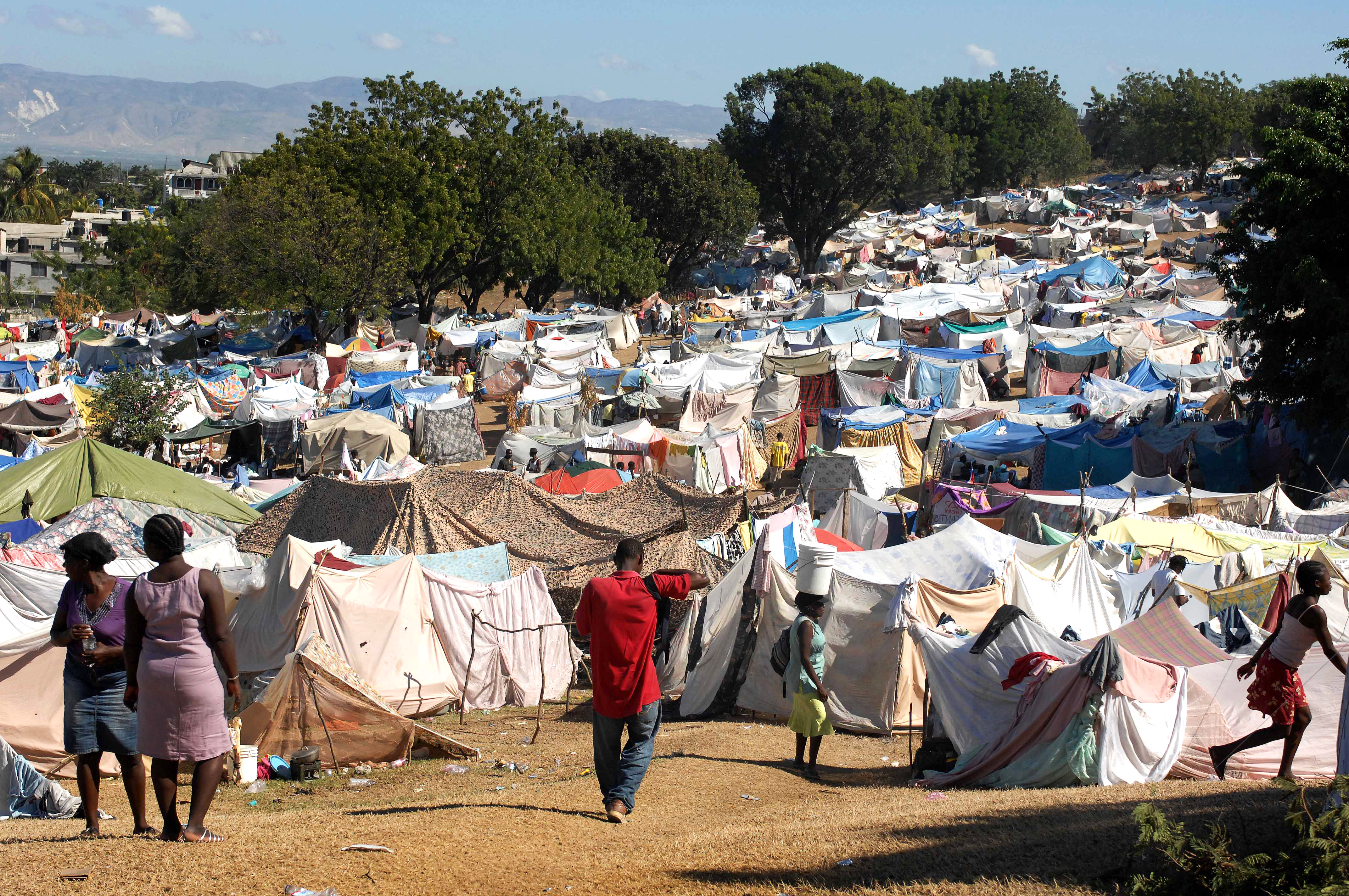
One appreciates that life on this planet is a little chaotic.  That means natural disasters happen.  I'm not quite sure how a loving deity allows people to die in natural disasters, as the freewill argument seems moot in these cases.  The deaths and suffering are not caused by human agency.

Tent City- Port au Prince (Wikipedia commons)

Nonetheless, the real point is how unjust these disasters are.  They impact the poorest and most vulnerable communities the most.  In 2010 a magnitude 7.0 earthquake hit Haiti.  The death toll was somewhere between 100,000-300,000 people. The same year a 7.1 earthquake hit Christchurch in NZ.  One person died of a heart-attack, that might have been caused by it.  The effects are not equal.

If we're going to propose any kind of argument that humans have to put up with natural disasters, at the very least, these should not be so manifestly unjust.   Having a system that harms those communities least able to cope contradicts the alleged characters of the Christian deity.

7. Baby I call Hell

Like everything to do with the afterlife, Hell is difficult to pin down.  Is it a place of heinous torture as described by Dante and other evangelical pastors?  Or is is an eternal separation from this deity?  Given the wide-spread dogmatic belief that it is torture (and I've been threatened often enough with it), then it's irreconcilable with a just and loving deity.

 The infraction against this god is transitory in nature. All I have done is not believe it existed. That merits an infinite punishment- one that is unusually cruel, barbaric and inhumane.

Hell- Wikipedia Commons

Hell and a loving, just deity cannot both exist.

8. She blinded me with science

I appreciate that ancient people could not have had with their knowledge, the language of concepts to describe the world in scientific terms.  Nonetheless, it seems odd that many ideas about the world are simply and blatantly wrong.  The microscopic world, the scale of the universe, that earth is not its centre, that life originated billions of years ago and then evolved are in conflict with many religious dogmas.  It's not a good advertisement for these beliefs to be true.

9. It's a small world

It is inescapable that the events of the bible are restricted to a tiny part of the world.  Most of Asia, Africa, the Americas and Oceania are excluded.  For a universal deity, this is suspiciously parochial.  It is according to the Abrahamic religion capable of communicating in all kinds of ways.  There are burning bushes, talking donkeys, angels etc.  But only a small tribe of pastoralists are selected for this direct communication.  In particular, a tribe that whose accomplishments were so minor, they had little ability to communicate their god to others.  While civilisations around them developed maths, astronomy, engineering, democracy and philosophy, ancient Judea developed, well, penis modification.

Even within that context, only a small part of the population is considered worthy of this message.  This part being men, of course.  For a universal deity that considered all to be equal, this incredible favoritism does not make any sense.

10. Free Fallin'

The problem with an all-knowing (omniscient) god is well known.  It makes free-will a fantasy.  If a deity knows everything I'm going to do and say over my life-time, there's nothing I can do to change that.  If Abe's god knows I'm going to have sushi for lunch, then I cannot choose anything else.  That extrapolates to every other action I take, to very word I utter.  I cannot choose anything, choice is an always following a single course of action.  I can only say the lines I was given.  I can only play the role I was destined to play.

Life in this case, is meaningless.  If I am going to hell, then, nothing I do over my life will change that.  I can only undertake the actions this deity already knows I'll take.  All life is, is a brief moment where I can change nothing, followed by an eternity of hell.  There's no point to this life at all.  This god may as well put those destined to hell, straight there.  Because nothing will change that destiny.


Monday, 6 June 2016

How improbable is it that proteins can form by "chance"?

A common trait of scientists who work on the origins of life, is not to attempt to estimate the probability macromolecules (like peptide chains) will form. A common trait of creationists who don't, is estimating such probabilities.  This typically produces astronomical odds against such macromolecules forming.

For instance, suppose we are told there is a 50:50 chance that two amino acids will bond.  A peptide-chain (protein) 150 amino-acids long, will thus have the probability of (0.5)*(0.5)^2*(0.5^3)*...(0.5)^150.  This gives a cumulative probability of well, a really really big number against (1 in 1045 IIRC).  Thus the number of trials needed to make this peptide seem up there in many billions of trillions.

The problem above is simple. It ignores the fact that macro-molecules form in a modular fashion. (There's also some assumptions about the chemistry also, but we'll put those aside).  Macromolecules don't form one molecule at a time, in one go.  If we just add one correction to the calculation above- that the peptide chains form in a modular way, it takes just 5 trials to make a chain 150 amino-acids long.  That's right. Just 5.  The Creationist result above are entirely produced by unrealistic assumptions.

Let me demonstrate.  We start with a large pool of amino-acids.  There's a 50:50 chance in the first round, they bond to another amino acids (using SIPF chemistry, dipeptides are found within a week).  This is merely the assumption from the creationist maths above.

So after trial 1:
Half the amino-acids have formed dipeptides (a chain of 2 amino acids)

Half the amino acids are still unpaired to anything.

We then carry these into trial 2:
Some of the amino acids will still not have bonded.  Some will form dipeptides.
Some of the dipeptides will bond to one other single amino acids (making a tripeptide)
Some of them will bond to another bipeptide, or to two single amino acids.  (Bonding can occur at either end of the chain, it doesn't have to be at just one end).  That's an oligopeptide 4 amino-acids long.
Importantly, some of the dipeptides will bond to two other dipeptides.  After two trials, we will find peptide chains 6 amino-acids long.

On to trial 3:
Some of the peptide chains 6 amino-acids long, will bond to two other 6 amino-acid peptides.  Some of the peptide chains are now 18 amino-acids long.  The distribution of peptide chains in the pool will range from 1 to 18 amino-acids long.

On to trial 4:
Some of the 18 amino-acid chains will bond to two other 18 amino acids.  We will find in the sample, anything between 1 amino acid to chains 54 amino-acids long.  


On to trail 5:
If 3 peptide chains that are 50-54 amino-acids long bond, then we've got our 150 amino-acid peptide chain.  We didn't need trillions of trials. It's that simple.

Ok.  This is a gross simplification.  The chemistry of peptide formation is a lot more complex than just two molecules randomly bonding.  That's why people who actually work in this topic, don't try to calculate probabilities.  There are too many variables and too many permutations to make any estimate meaningful.  The point is to show how utterly devious and dishonest it is, to drop the modular assumption of macro-molecule formation.  And why you actually need to use a Markov probability function, not an IID.  What happens in each trial is not independent of previous trials. The reason creationists use an IID is because it's the one function everyone knows, and it wildly inflates the improbability of anything happening.


Wednesday, 7 October 2015

The Dilemma with "Kinds"

@Atheistic_1 Sep 27 (Twitter)

Kent Hovind breaks down "kinds": "Everyone knows birds are different than fish." 

Anyone familiar with creationists know that they generally eschew scientific classification of organisms. Rather, they try to reclassify life into what is they term kinds.  It doesn't take long to work out they can't actually define kinds.  They'll throw out what they think are examples of kinds, but they cannot specify the criteria to separate kinds.

So why not simply treat kinds as a synonym for species?  The answer is the Ark.  The idea that all of this planet's terrestrial animal species could fit on the Ark (and let's face it, this is supposed to include extinct taxa like dinosaurs also), is impossible.  So by using larger groups, the cramming task is made less difficult.  Perhaps there is only one cat-kind. Thus all Noah needed was this single pair, rather than representatives of all extant Felidae.

Kinds need a broad definition to fit everything into the Ark


So kinds have to be defined in a broad way, to cluster lots of species together.

But kinds have to be narrowly defined to separate us from apes
This creates the dilemma. The dilemma is us- humans.  Genetically we are more closely related to chimpanzees, than chimpanzees are to gorillas (and other great apes).  So if the point of using kinds is to 'cluster' animal species into groups, we'd be a kind of chimpanzee (or even an ape).  This conflicts with a special creation of humans out of dirt.  We are according to creationists, distinct from all the other animals. This means kinds has to be now revised to mean something incredibly narrow.  It has to be so narrow it can separate us from all other ape species.


The requirement for kinds to be both a way of broadly defining life, and at the same time, even narrower than scientific classification systems, is impossible to pull off.  And for that reason, kinds cannot ever be supplied with an actual definition.  They can only flounder in their futile attempt to meet their two goals.

Monday, 17 August 2015

The problem with witches

There are many reasons I don't believe in the god of Abraham. One of these reasons is the killing of "witches". This brutal fact, this product of religion,  is completely at odds with the alleged traits of this god.  In short, if there is an omniscient being (who knows all) and who truly cares for humanity, then the hideous deaths of those accused of witchcraft refutes that entity.  Let me elaborate.

The bible is very clear on what to do with witches.
Thou shalt not suffer a witch to live Exodus 22:18
Because witchcraft is a fictional crime, it means throughout history, countless innocents have died as a consequence of this.  Some 40-50,000 people have been killed for witchcraft in Western countries, many in quite hideous ways.  Violent attacks on witches still continue today. A UNICEF 2010 report details attacks on child-witches sic in Africa. Children with disabilities are especially targeted. Such attacks are far more common in Christian communities than Muslim.  The link is to the biblical command to kill witches. 

Now clearly, an omniscient entity would know all of this back in the "Exodus" era.  It would know that including this command would mean say, that a child with epilepsy, would be betrayed and violently attacked by the adults in his or her community. That even if they did not die, the risks they faced would inflate the likelihood of an early death.  About 20,000 streetchildren had been accused of witchcraft in the DR Congo capital Kinshasa


Knowing this, knowing that mere children would be murdered as a consequence of Exodus 22:18, this entity still allows it to be included.  So here's the question. If you knew that this edict would result in the deaths of thousands of innocents, that children would be attacked and murdered, would you include it in a text that communicated your wishes? 


This is the dilemma. If you include it, you will be responsible for the inhumane deaths of these people. If you were a benevolent and loving and deity- and your omniscience meant you could see the consequences of all your edicts- would you really include this passage?

Let's play the context game. Let's play the excuse that this is all Old Testament stuff. That there is some context here that's been overlooked. Overlooked for centuries even, as killing people for witchcraft as been a Christian tenet for most of its history.


So, as an omnipotent and benevolent being, you have the means to tell the faithful that this verse say, no longer applies (or is being applied incorrectly). You can appear as a burning bush, or a talking donkey. You can send angels as messengers. If Christianity is correct, you can even make a physical manifestation of yourself as your own, mortal son about 2000 years ago.

So about 2000 years ago, all you had to do was say something. Not do something, not change the laws of the universe. All you'd have to do is explain that Exodus 22:18 no longer applied.

If you did that, then thousands would not have died in flames in Europe.  Kids with epilepsy or autism would not be beaten, assaulted or killed.

Such a little thing.

Yet there is no record of this.

I doubt that anyone of us, with so many lives at stake, with the most vulnerable people (kids with disabilities) being the target of this, could choose not to make this clear.

You cannot claim there is an omniscient, moral and benevolent, who intercedes in this world, when the body-count of the innocents is so high. Omniscience means you must know what Exodus 22:18 leads to. Benevolence means you must do everything to prevent the consequences of that. Omnipotence gives you the power to do so. In no state of the world, does this combination explain why kids are being killed for witchcraft.


Friday, 20 February 2015

Scientific Definitions of Evolution


The "Modern Synthesis", which is the foundation of modern biology, occurred during the 1930s and 1940s.  It brought together Darwin's evolutionary mechanisms of selection (noting Darwin explicitly stated these were not the only mechanism), with Mendelian genetics and paleontology.  Combining Mendelian genetics with Darwin's mechanisms took the work of Fisher and the like.  These used statistical methods to show how gradual changes would occur.  Paleontology  by this stage, had discovered sufficient transitional forms to make evolution on these geological time scales accepted.

This synthesis provides the definition of evolution we use today.  The term 'descent with modification' is more a description than a definition.  I list a sample of these definitions here.  The key points is that evolution is about genetic, inheritable changes in populations.

Non-inheritable changes (like amputations) are not evolution.  Evolution does not mean a cat gives birth to a dog, or a monkey gives birth to a human.  It operates at the level of populations.

Theodosius Dobzhansky (1937) Genetics and Origin of Species
Evolution is a change in gene frequencies through time
John Maynard Smith (1958) The Theory of Evolution
 Evolution is merely a reflection of changed sequences of bases in nucleic acid molecules
David L Kirk (1980) Biology Today. 3rd ed.
a progressive, heritable change in gene frequencies in a population through succeeding generations, as a consequence of processes such as mutation, natural selection, and genetic drift
 Helena Curtis and N. Sue Barnes (1989), Biology, 5th ed.
In fact, evolution can be precisely defined as any change in the frequency of alleles within a gene pool from one generation to the next.